FFFK6193 – Computer Based Analysis Using R Studio

Use the notes from here – https://www.slideshare.net/mobile/drtamil/introduction-to-data-analysis-with-r-and-r-studio

Use your browser to download your Excel data from the following link;

Click HERE

Do the following analysis on the data using R Studio then submit your answers via this LINK.

A study to identify factors that can cause small for gestational age (SGA) was conducted. Among the factors studied were the mothers’ body mass index (BMI). It is believed that mothers with lower BMI were of higher risk to get SGA babies.

1. Create a new variable mBMI (Mothers’ Body Mass Index) from the mothers’ HEIGHT (in metre) & WEIGHT (first trimester weight in kg). mBMI = weight in kg/(height in metre)2. Calculate the following for mBMI;

  • Mean
  • Standard deviation

Copy and paste your answers into your Word file.

2. Create a new variable OBESCLAS (Classification of Obesity) from mBMI. Use the following cutoff point;

  • <20 = Underweight
  • 20 – 24.99 = Normal
  • 25 or larger = Overweight

Create a frequency table for OBESCLAS. Copy and paste the table into your Word file.

3. Conduct the appropriate statistical test to test whether there is any association between OBESCLAS (Underweight/Normal/Overweight) and OUTCOME.

Copy and paste the appropriate tables along with the interpretation into your Word file.

4. Conduct the appropriate statistical test to test whether there is any association between BMI and OUTCOME.

Copy and paste the appropriate tables along with the interpretation into your Word file.

5. Conduct the appropriate statistical test to find any association between OBESCLAS (Underweight/Normal/Overweight) and BIRTHWGT.

Copy and paste the appropriate tables along with the interpretation into your Word file.

6. Assuming that both variables mBMI & BIRTHWGT are normally distributed,

  • conduct an appropriate statistical test to prove the association between the two variables.
  • Demonstrate the association using the appropriate chart. Determine the coefficient of determination.

Copy and paste the above charts and your answers into your Word file.

7. Conduct Simple Linear Regression using BIRTHWGT as the dependent variable. Try to come out with a formula that will predict the baby’s birth weight based on the mother’s BMI.

y = a + bx

Copy and paste the appropriate tables and supporting chart along with the interpretation into your Word file.

Copy all the text (Ctrl-A, Ctrl-C) in the Command window and paste (Ctrl-V) into your Word file.

Save your Word file using your matric number as its filename i.e. P163341.doc. Now transfer your answers from the Word file onto this online form at LINK. Upon finishing, please click the SUBMIT button to submit your answers.

Just in case your answers go missing in the ether of cyberspace, please upload that file here in the Google Form.
Posted in FK6193, Minitest, R | Tagged , | 3 Comments

FK6193 – 3rd Assignment

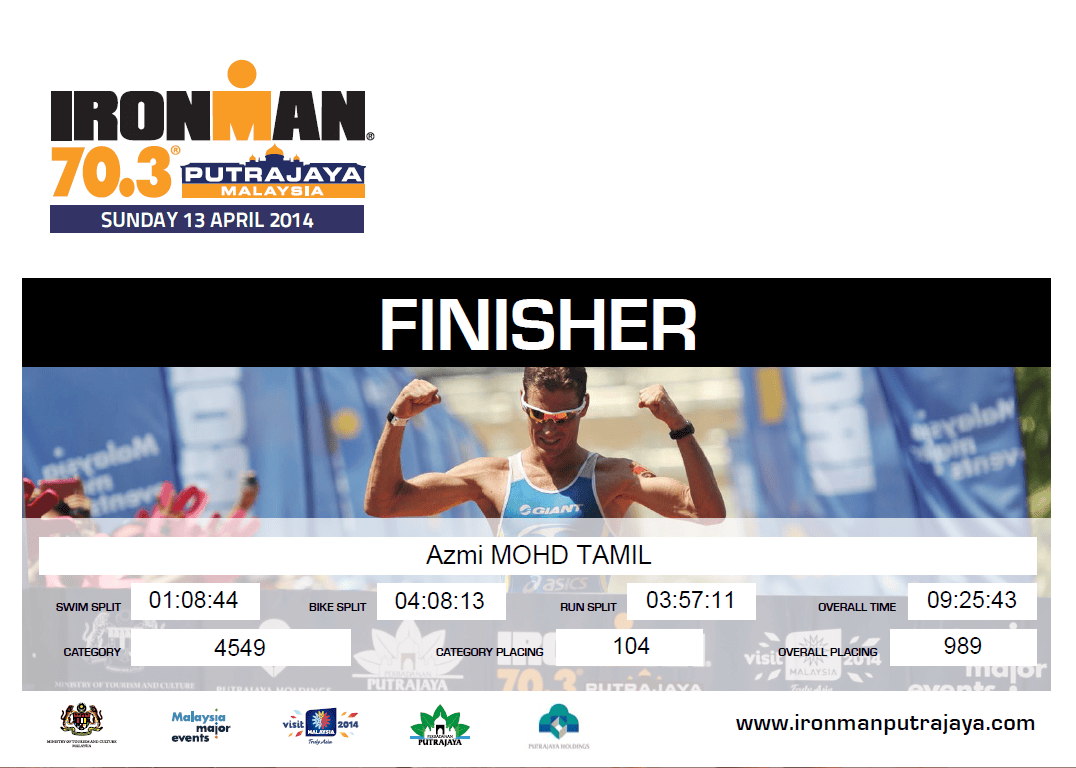
At the Putrajaya Ironman 70.3 on 13th April 2014, 1234 triathletes registered for the individual event. However around 155 of them chickened out and did not turn up at the start of the swim event (Did Not Start aka DNS). 1079 triathletes took part in the swim event. However only 991 triathletes completed the entire course of 1.9 km swimming, 90 km cycling and 21.1km running. About 88 of them did not finish (DNF) due to various reasons.

Please download the following data of the event from this LINK. The data consists of the following information;

  • Country of origin
  • Country of origin (grouped into 6)
  • Swim duration in minutes
  • Status of swim (completed = 1)
  • Cycle duration in minutes
  • Status of cycling (completed = 1)
  • Run duration in minutes
  • Status of run (completed = 1)

Please answer the following questions based on analysis of the data. Copy and paste the appropriate tables and charts into your Word document along with the interpretation.;

  1. Of the 1079 starters, how many participants completed the swim leg? Copy and paste the appropriate frequency table into your answer sheet along with the answer.
  2. Of those who completed the swim leg, how many completed the cycle leg? Copy and paste the appropriate frequency table into your answer sheet along with the answer.
  3. Of those who completed the cycle leg, how many completed the run leg? Copy and paste the appropriate frequency table into your answer sheet along with the answer.
  4. Plot an overall survival plot of the swim leg and generate the mean/median survival time. Copy and paste the appropriate table and survival plot into your answer sheet along with the interpretation. DO NOT COPY PASTE THE SURVIVAL TABLE.
  5. Plot an overall survival plot of the cycle leg and generate the mean/median survival time. Copy and paste the appropriate table and survival plot into your answer sheet along with the interpretation. DO NOT COPY PASTE THE SURVIVAL TABLE.
  6. Plot an overall survival plot of the run leg and generate the mean/median survival time. Copy and paste the appropriate table and survival plot into your answer sheet along with the interpretation. DO NOT COPY PASTE THE SURVIVAL TABLE.
  7. Generate the survival plot comparing the duration of swim time between country group. Generate the mean/median survival time of each country group. Is the difference of swimming duration between countries significant? Compare my swim time against the Malaysian mean/median swim time. How bad was it? Copy and paste the appropriate tables and charts into your answer sheet along with the interpretation. DO NOT COPY PASTE THE SURVIVAL TABLE.
  8. Generate the survival plot comparing the duration of cycle time between country group. Generate the mean/median survival time of each country group. Is the difference of cycling duration between countries significant? Compare my cycle time against the Malaysian mean/median cycle time. How bad was it? Copy and paste the appropriate tables and charts into your answer sheet along with the interpretation. DO NOT COPY PASTE THE SURVIVAL TABLE.
  9. Generate the survival plot comparing the duration of run time between country group. Generate the mean/median survival time of each country group. Is the difference of running duration between countries significant? Compare my run time against the Malaysian mean/median run time. How bad was it? Copy and paste the appropriate tables and charts into your answer sheet along with the interpretation. DO NOT COPY PASTE THE SURVIVAL TABLE.

Save your Word file using your matric number as its filename i.e. P20627.doc. Send it as an attachment via email to statsexam@gmail.com, using your matric number as its subject header. All answers must be sent to that email address before 12.00 noon 9th June 2020. No marks will be given for answers received after 12 noon 9th June 2020.
Good Luck!

Posted in FK6193, Minitest | Leave a comment

FFFK6193 – Assignment 2 – GLM

Use your browser to download your assignment data from the following link;

http://www.palmx.org/drtamil/2020/May2020/mactricno.zip

If your matric number is P162824, then download your SPSS data from;

http://www.palmx.org/drtamil/2020/May2020/P162824.zip

Do the required analysis on the data using SPSS then submit your answers in the Word file (e.g. P162824.doc) via email to statsexam@gmail.com, using your matric number (i.e. P162824) as its’ subject header, before 10 May 2020 11.59pm.

Posted in Assignment, FK6193, SPSS | Tagged , | Leave a comment

FFFF3618 – Computer Based Examination

Use your browser to download your SPSS data from the following link;

http://www.palmx.org/drtamil/2020/mco3/mactricno.sav

If your name is MOHAMAD AZIZI BIN MOHAMAD ZULKIFLE and your matric number is A162824, then download your SPSS data from;

http://www.palmx.org/drtamil/2020/mco3/A162824.sav

Do the following analysis on the data using SPSS then submit your answers via this LINK.

A study to identify factors that can cause small for gestational age (SGA) was conducted. Among the factors studied were the mothers’ body mass index (BMI). It is believed that mothers with lower BMI were of higher risk to get SGA babies.

1. Create a new variable mBMI (Mothers’ Body Mass Index) from the mothers’ HEIGHT (in metre) & WEIGHT (first trimester weight in kg). mBMI = weight in kg/(height in metre)2. Calculate the following for mBMI;

  • Mean
  • Standard deviation

Copy and paste your answers into your Word file.

2. Create a new variable OBESCLAS (Classification of Obesity) from mBMI. Use the following cutoff point;

  • <20 = Underweight
  • 20 – 24.99 = Normal
  • 25 or larger = Overweight

Create a frequency table for OBESCLAS. Copy and paste the table into your Word file.

3. Conduct the appropriate statistical test to test whether there is any association between OBESCLAS (Underweight/Normal/Overweight) and OUTCOME.

Copy and paste the appropriate tables along with the interpretation into your Word file.

4. Conduct the appropriate statistical test to test whether there is any association between BMI and OUTCOME.

Copy and paste the appropriate tables along with the interpretation into your Word file.

5. Conduct the appropriate statistical test to find any association between OBESCLAS (Underweight/Normal/Overweight) and BIRTHWGT.

Copy and paste the appropriate tables along with the interpretation into your Word file.

6. Assuming that both variables mBMI & BIRTHWGT are normally distributed,

  • conduct an appropriate statistical test to prove the association between the two variables.
  • Demonstrate the association using the appropriate chart. Determine the coefficient of determination.

Copy and paste the above charts and your answers into your Word file.

7. Conduct Simple Linear Regression using BIRTHWGT as the dependent variable. Try to come out with a formula that will predict the baby’s birth weight based on the mother’s BMI.

y = a + bx

Copy and paste the appropriate tables and supporting chart along with the interpretation into your Word file.

Save your Word file using your matric number as its filename i.e. A163341.doc. Now transfer your answers from the Word file onto this online form at LINK. Upon finishing, please click the SUBMIT button to submit your answers.

Just in case your answers go missing in the ethers of cyberspace, please email the above Word document file (e.g. A163341.doc) to statsexam@gmail.com, using your matric number (i.e. A163341) as its’ subject header.

Posted in FF3618, FK6163, FK6163(E), FK7322, Minitest, SPSS | Tagged , | 1 Comment

Protected: UM Oncology Stats Short Course 09/02/2020

This content is password-protected. To view it, please enter the password below.

Enter your password to view comments.

Protected: FK6342 – Policies & Standards of HIS

This content is password-protected. To view it, please enter the password below.

Posted in FK6342, Lectures | Enter your password to view comments.

FF2613 – Project Presentation 2019

Lab 1

Lab2

Lab 3

Lab 4

Lab 5

Lab 6

Lab 7

Lab 8

Lab 9

Lab 10

Posted in Assignment, FF2613 | 1 Comment

MP21 – Research Week 2019


setmore

  1. Sample Size Calculation
  2. Exploratory Data Analysis & Summary
  3. Testing Hypothesis
  4. Chi-Square & easier set of notes
  5. T-test & ANOVA & easier set of notes
  6. Correlation & Regression
  7. Non-Parametric Tests
  8. Clinical Agreement & Kappa
Posted in MP14 | Leave a comment

FK6193 – CL13 Conditional Logistic Regression

Data YH Chan

Data Malaria

Click HERE to download Lecture Note in pdf format.

Posted in FK6193 | Leave a comment

FK6193 – Introduction Into AMOS

Data for practical, arranged in order of exercises;

  1. AMOS-kvsperform1.sav
  2. AMOS-kvsperform2.sav
  3. AMOS-Grnt_fem.sav
  4. AMOS-fitness-parameter.txt
  5. PF-MH-AMOS.sav
  6. PFMH.sav


Video of Part 1 of the lecture

Posted in FK6193, Lectures | Leave a comment